

Most people need 1–3 HIFU sessions to achieve meaningful skin tightening. After that, maintenance every 12 to 18 months helps you keep those results. Your exact number depends on your age, skin laxity, and the treatment area. HIFU works gradually, so multiple rounds are normal and expected. This complete guide gives you the facts you need. Your provider will help you decide how many treatments you need. This approach is non-invasive, and your skin responds over time. A qualified provider can tailor a plan for you. Patience pays off here. Your skin will thank you. The process is gentle and safe. Many people see visible improvement. Your skin will look naturally lifted.
Key Takeaways

Most people need 1 to 3 HIFU sessions for noticeable skin tightening.
Maintenance sessions every 12 to 18 months help keep your results.
Your age, skin laxity, and treatment area affect the number of sessions.
HIFU works gradually, with full results appearing after 3 to 6 months.
A single session can show early tightening, but multiple sessions may be needed.
Space sessions about 3 months apart to allow collagen rebuilding.
Lifestyle habits like sun protection and no smoking extend your results.
Consult a qualified provider to create a personalized treatment plan.
How HIFU Works and Why Results Build
HIFU Science Made Simple
Focused Ultrasound and Collagen

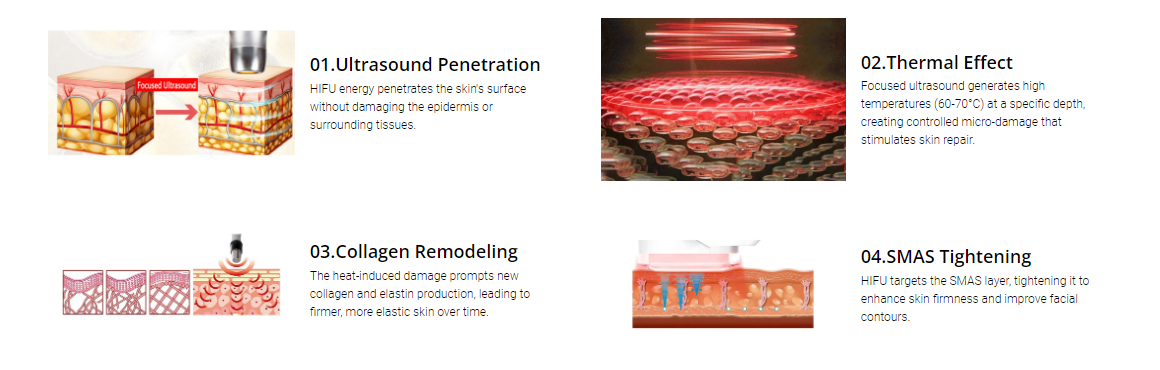
High-intensity focused ultrasound delivers precise beams of ultrasound energy into your skin. A concave transducer focuses megahertz-frequency waves into small tissue volumes. This creates millimeter-scale beam spots at exact depths. The absorbed acoustic energy raises the focal temperature above 55°C. This heat causes coagulative necrosis only at the focus. Surrounding tissue stays safe at non-cytotoxic temperatures.
These thermal coagulation points trigger your body’s wound-healing cascade. Fibroblasts activate and begin producing new collagen and elastin. Early Type III collagen later remodels into stronger Type I collagen. This process gradually firms your dermis from within.
MinXu HIFU combines HIFU with Radio Frequency technology. This dual-action approach targets the SMAS layer—the same layer addressed in surgical facelifts. The SD probe emits HIFU as a single dot from the center while bipolar RF energy radiates from the edges. You receive simultaneous treatment at different depths without changing probes.
HIFU can produce focused, microthermal lesions at precise depths in the mid-to-deep dermis up to 6–7.8 mm deep, reaching the SMAS layer to induce neocollagenesis and neoelastogenesis, while RF can deliver uniform heat up to 2–4 mm deep within the dermis, causing neocollagenesis and neoelastogenesis more diffusely including the upper papillary dermis.
Why Skin Needs Time to Respond
Your skin follows a biological timeline. Initial tightening can appear within days. Peak results develop at 3–6 months as collagen remodeling completes. Tissue remodeling remains active for about 12 months. This hifu results timeline explains why patience matters.
| Phase | Timeframe | Expected Effect |
| Immediate response | Days 1–3 | Mild tightening and slight immediate lift |
| Early remodeling | Weeks 2–6 | New collagen begins forming; subtle firmness improvement |
| Peak results | Months 3–6 | Maximum visible tightening and lifting |
| Long-term remodeling | Up to about 12 months | Remodeling continues while effect gradually fades |
Why One Session Is Rarely Enough

A single session produces visible hifu results. Full improvement develops over 3 to 6 months. Your body needs this time to build new collagen. One treatment starts the process. Optimal outcomes often require additional sessions.
The table below shows how combined HIFU and RF technology enhances outcomes compared to HIFU alone:
| Parameter | HIFU-only | HIFU + Bipolar RF |
| Pore number | Improved | Significantly greater reduction |
| Skin elasticity | Improved | Significantly enhanced |
| Eye wrinkle depth | Reduced | Significantly diminished |
| Skin density at 4 weeks | Increased | Significantly greater increase |
| Facial lifting | Significant improvement | No significant intergroup difference |
The Progressive Nature of HIFU

Your treatment works in stages. Focused energy delivery creates thermal coagulation points at set depths. Localized heat generation denatures existing collagen. Immediate collagen contraction produces instant tightening. The wound-healing response then activates fibroblasts. Neocollagenesis and remodeling follow over months.
This progressive mechanism means each session builds on the last. The typical results timeline shows gradual improvement rather than instant transformation. You see natural-looking changes as your skin renews itself.
How Many HIFU Sessions Do You Need?
Most patients need 1 to 3 HIFU sessions total. That wide range can feel frustrating, but it protects you from over-treatment. Your age, skin quality, and treatment area all change the final count. A reputable provider will examine your skin and create a plan you can trust.
Typical Session Counts
Clinics generally recommend 1–2 sessions per year. A common protocol uses 3 treatments spaced 3 months apart. After those three visits, you can wait up to 2 years before needing more work. This schedule is ideal for mild to moderate skin laxity. Younger clients often finish with fewer visits. Clients with more visible aging usually need the full series.
Think of the process as a staircase. The first treatment wakes up your collagen. The second deepens the response. The third locks in the lift. You can stop at any floor where you feel satisfied.
| Device type | Typical number of treatments to achieve optimal skin tightening | Key supporting notes |
| MinXu HIFU | 1 session | Pairs HIFU with radio frequency and can target the SMAS layer; visible lifting can last 2–3 years. |
| Conventional HIFU | 1–3 sessions | One session may work for mild-to-moderate laxity; thicker skin or deeper sagging may require more visits, usually spaced 3–6 months apart. |
That table gives you a realistic benchmark. It also explains why your friend’s plan may not match yours.
How Many Treatments for Best Results

A single session can trigger visible lifting, though the deepest change takes 3–6 months. Many people book a second treatment 3 months later. Others need 2 sessions to complete the remodeling phase. If you use a conventional device, expect 2-3 sessions for complete remodeling. The final visit often produces the maximum lifting and tightening effect.
MinXu HIFU changes that math. Because it combines HIFU with radio frequency, every pass stimulates more tissue. You may need fewer visits than a standard plan. Some users see their goal after just one visit. Others prefer a second visit to refine the jawline or cheeks. When you ask your provider how many treatments your skin requires, you can expect a shorter answer.
| Patient factor | How it influences session number |
| Skin laxity | More sagging demands extra sessions. |
| Age and collagen production | Older skin or low collagen output may need maintenance sooner. |
| Skin thickness and resilience | Thick, elastic skin often finishes faster; thin or sun-damaged skin may need more. |
| Treatment area | Larger areas or deep wrinkles may push you toward the upper end of the range. |
These factors explain why the 1-to-3 range exists. Your provider balances every detail before making a recommendation.
Factors That Change Your Session Count
Age drives much of the variation. Skin in its twenties produces collagen readily, so 1–2 treatments may be plenty. In later decades, that supply slows down. You may need all three treatments to build the same support. Natural aging continues after your sessions end, so a follow-up every 1–2 years helps you keep the lift.
Skin condition matters equally. This milder grade of laxity fits neatly into the 1–3 session range. Severe sagging or deep wrinkles require the top of that range. Sun damage and genetics also affect the outcome. You cannot control those inputs, but a good provider can adjust the plan around them.
The treatment area changes the count as well. The face responds faster than the neck or body. A full-face plan may need broader coverage than a single jawline treatment. The provider chooses different depths for each region, so you may receive extra passes in stubborn zones.
Once you reach your goal, plan a touch-up every 9–18 months. Some clients stretch that interval to 2–3 years with MinXu HIFU. With that technology, results can last longer, which lowers your total visits over time.
So, how many HIFU sessions do you need? The honest answer is 1–3 sessions for most people. Start with a consultation. Your provider will design a plan that fits your skin, your schedule, and your budget.
What to Expect From Your First HIFU Session

Image Source: pexels
Results After Session One
A single hifu session produces visible results. You may notice mild tightening within days. Full improvement develops over 3 to 6 months as your collagen remodels. Your provider may recommend a follow-up at 12 to 18 months to maintain those hifu results.
The first session starts a biological process. Your skin responds to the ultrasound energy by building new collagen. This process continues for months after your appointment. You will see gradual changes rather than an instant transformation.
Session Duration and Comfort
Each HIFU session typically lasts 30 to 90 minutes. The exact time depends on the treatment area and the number of passes. A full-face treatment with a standard HIFU machine typically uses 500–800 shots. Your provider adjusts the spacing and shot count based on your needs.
| Treatment area | Approximate number of lines |
| Under-eye area + nasolabial folds | 300 Lines |
| Cheeks or double chin | 100 Lines |
| Cheeks + double chin | 300 Lines |
| Full face or upper arms | 600 Lines |
| Full face + neck or thighs | 1,000 Lines |

HIFU is generally well-tolerated. Some individuals experience mild discomfort or a tingling sensation during treatment. You may feel warm sensations or prickling as the device delivers energy. These feelings are normal and temporary.
MinXu HIFU offers a painless, downtime-free experience. The dual-action technology combines HIFU with radio frequency to target the SMAS layer. This approach achieves optimal results in fewer sessions.
Downtime and Recovery
There is little to no downtime after HIFU treatment. You can return to most normal activities immediately. Many patients go back to work or daily routines right after their appointment.
Temporary side effects may include mild redness, slight swelling, tenderness, or tingling. These effects are normal and usually settle within a few hours to a few days. Bruising is rare and typically limited to a small area. Temporary numbness or tingling is also rare and generally resolves quickly.
Your first session marks the beginning of your skin rejuvenation journey. The results build over time. You will see the full benefits of your treatment within 3 to 6 months.
When You Might Need More HIFU Sessions
Some people achieve their goal after one visit. Others need the full series of three. Your skin tells the truth. Age and laxity severity drive the final count. Let’s explore those factors.
Pronounced Laxity and Older Age
No absolute age cut-off exists. Being over 50 or even 60 does not disqualify you from HIFU. The key factor is your degree of laxity. A 55-year-old with moderate laxity can be a better candidate than a 35-year-old with severe sagging.
Mild to moderate laxity responds well. You can see meaningful tightening without surgery.
Pronounced laxity, such as heavy neck folds or draping skin, limits the lift you can achieve.
Severe laxity will not correct with more sessions. A surgical facelift or neck lift remains the appropriate choice.
Realistic expectations protect you from disappointment. This technology handles mild-to-moderate laxity best. Severe folds or drooping skin need surgical options, not extra visits.
Your 50s often bring pronounced laxity and deep wrinkles. HIFU can still tighten skin effectively. Your 60s and beyond may require several sessions to reach the best results. Suitability depends on severity, not age alone.
Mature patients generally need additional sessions or more frequent visits. Combining this approach with other anti-aging procedures helps when sagging is severe.
Body vs. Face Treatments
Body and face treatments follow different rules. Body tissue is thicker. It demands different cartridge depths than facial skin. Treating the face and neck may use 1.5mm, 2mm, and 3mm cartridges. Each depth targets a distinct layer.
MinXu offers customizable treatment depths. You can address specific concerns on your forehead, jawline, cheeks, or under-eye area. The provider selects the right depth for each zone. This precision improves your outcome without extra visits.
Body areas, like thighs or upper arms, often need deeper cartridges. The thicker tissue requires more energy to trigger collagen. Your provider maps the area and adjusts the plan accordingly. The provider chooses depth based on your tissue thickness. This customization keeps each session safe and effective.
Spacing Sessions for Best Results
Spacing matters as much as the total count. The standard protocol spaces sessions three months apart. This gap gives your skin time to build new collagen. Each session builds on the previous one.
Collagen remodeling takes time. Improvements peak at 3 to 6 months. If you schedule sessions too close together, you waste your investment. The skin cannot respond faster than biology allows. The three-month interval also helps your provider track progress. They can decide whether you need a second or third visit.
Follow the three-month spacing rule. Your provider will tell you when your skin has matured enough for the next pass. Patience protects your investment. Some patients stop after two sessions once they see their goal.
Maintenance HIFU Sessions and Timing

Image Source: pexels
The 12–18 Month Window
Your initial HIFU sessions build the foundation. Maintenance sessions protect that investment. Most people return for a touch-up around 12 to 18 months after their first course. Clinical evidence supports this window. According to Dr. Geldres at Elyzea, patients are typically advised to undergo a maintenance HIFU session every 12 to 18 months to sustain results. Your age, skin quality, and lifestyle all influence this timeline.
A simple pattern works well for most people: one to two maintenance sessions per year. Some providers recommend a general maintenance program spaced 6–12 months apart. Others suggest two treatments in the first year, spaced 2–4 months apart, followed by one treatment per year. Touch-ups are sometimes recommended at 3–12 months depending on individual goals.
MinXu HIFU results can last 2–3 years. This longer durability may extend your maintenance interval. You might need fewer visits over time compared to conventional devices. That extended timeline offers both convenience and cost savings.
Signs You Need a Touch-Up
Your skin gives clear signals when it needs attention. Watch for gradually returning laxity around your jawline or cheeks. You may notice your skin feeling less firm than it did a few months ago. These early signs mean your collagen support is fading.
Do not wait for dramatic sagging. A timely maintenance session restores your results before significant changes appear. Your provider can assess your skin and recommend the right timing. Some people schedule touch-ups based on calendar dates. Others wait for visual cues. Both approaches work well.
Lifestyle Factors and Longevity
Your daily habits shape how long your results last. Sun exposure, smoking, and skincare routine all play significant roles. The table below summarizes their effects.
| Lifestyle factor | Effect on HIFU longevity | Recommendation |
| Sun exposure | UV damage accelerates skin aging and collagen breakdown, shortening results. | Use sunscreen daily and wear protective clothing. |
| Smoking | Smoking accelerates skin aging and shortens effectiveness. | Avoid smoking and maintain a healthy diet and hydration. |
| Skincare routine | Poor routines accelerate skin aging and reduce effectiveness. | Use collagen-promoting products such as retinoids, vitamin C, and hyaluronic acid. |
Protecting your skin between sessions preserves your tightening results. A consistent skincare routine with collagen-supporting ingredients helps maintain your outcome. Sun protection and healthy habits extend your timeline. These practical steps keep your skin looking its best.
Planning Your HIFU Treatments
Mapping a Treatment Calendar
A successful plan starts with a clear calendar. You follow the 3-month spacing protocol for your initial sessions. This gap allows your skin to rebuild collagen between visits. Scheduling sessions too close together can cause chronic inflammation or tissue damage. Your skin needs adequate recovery time.
Several factors shape your calendar. Your age, overall health, and skin condition all play a role. Active skin infections or severe inflammatory acne must resolve before you begin. Medical conditions and certain medications also affect timing. If you receive fillers, lasers, or neuromodulators, you need proper spacing between procedures. HIFU is often performed before fillers to protect filler integrity.
After your initial course, you enter the maintenance phase. Most people return for a touch-up 12 to 18 months later. Your provider will help you determine the right interval based on your individual response.
HIFU While Traveling Abroad
Choosing a Qualified Provider
Traveling abroad for hifu treatment requires careful planning. Verify whether the clinic is authorized to treat international patients. Confirm who will actually perform your procedure. Ask what medical evaluation is required before you travel. Clarify exactly what your treatment package includes. Understand how follow-up care works after you return home. Check that the clinic maintains sterile conditions and has emergency readiness. These steps protect your safety and ensure quality care.
Timing Sessions Around Travel
Plan your trip with recovery in mind. HIFU body treatments typically involve no downtime and minimal swelling. Most patients can travel the next day. An optimal stay duration of 2 to 5 days allows time for consultation, treatment, and rest. Full recovery takes 1 to 2 weeks. Many patients combine hifu with tourism, so a 4 to 6 day stay works well. Do not choose return flights based solely on ticket prices. Allow sufficient time for initial recovery and any necessary follow-up checks.
Budgeting for Multiple Sessions
Understanding costs helps you plan effectively. Salon or aesthetic HIFU typically costs $200 to $500 per session. Medical HIFU ranges from $500 to $1,500 per session. For a 3-session plan, you might budget roughly $600 to $1,500 at the salon level. At the medical level, the same plan could cost approximately $1,500 to $4,500. These figures help you prepare financially. Following evidence-based protocols ensures you invest wisely in your skin health.
Your tightening journey starts with a clear answer. Most people need one to three sessions, then a maintenance session every 12 to 18 months. In reality, your age, skin laxity, and treatment area shape the plan. A qualified provider assesses all three before recommending a schedule.
Knowing how many treatments you truly need starts with this conversation. The complete guide above explains why changes build gradually. You will not see instant perfection after one visit. Instead, collagen remodeling delivers strengthening over three to six months. You may only need one hifu treatment if your laxity is mild. Deeper sagging often requires the full series.
Your hifu results can last two to three years. Consult a trusted provider for a personalized plan. Your skin will reward you with natural-looking, lasting effects.
FAQ
How many treatments does a typical HIFU plan include?
Most people need 1 to 3 treatments total. Your age, skin laxity, and treatment area shape the final count. A common protocol spaces 3 sessions three months apart. After that, you may not need more work for up to 2 years.
Can I see results after just one session?
Yes. A single session produces visible tightening within days. Full improvement develops over 3 to 6 months as collagen remodels. Your provider may recommend a follow-up at 12 to 18 months to maintain those results.
How many HIFU sessions do you need for body areas?
Body treatments often require the same 1 to 3 range. Thicker tissue demands different cartridge depths than facial skin. Your provider selects the right depth for each zone. This precision improves your outcome without extra visits.
How many HIFU sessions do you need if you have severe laxity?
Severe sagging may need the full series of three. However, pronounced laxity will not correct with more sessions alone. A surgical facelift remains the appropriate choice for heavy neck folds or draping skin. Realistic expectations protect you from disappointment.
How long does each session last?
Each session typically lasts 30 to 90 minutes. The exact time depends on the treatment area and number of passes. A full-face treatment usually uses 500 to 800 shots. Your provider adjusts spacing and shot count based on your needs.
Is there any downtime after treatment?
There is little to no downtime. You can return to most normal activities immediately. Temporary redness, swelling, or tingling may occur. These effects usually settle within a few hours to a few days.
How often do I need maintenance sessions?
Most people return for a touch-up every 12 to 18 months. MinXu HIFU results can last 2 to 3 years. This longer durability may extend your maintenance interval. You might need fewer visits over time.
What factors affect how many sessions I need?
Age, skin condition, treatment goals, and provider recommendation all play a role. Older skin or low collagen output may need maintenance sooner. Larger areas or deep wrinkles may push you toward the upper end of the range.
Discover more from Minxu
Subscribe to get the latest posts sent to your email.